AI is Education: The End of the Journey
Executive Summary: The shift from search engines to generative AI is more than a technical upgrade; it is a fundamental metaphorical transformation. We are moving from “Knowledge as Journey”—a process defined by exploration, friction, and serendipity—to “Knowledge as Pedagogical Exchange,” where the destination is provided instantly. Because AI’s core logic is instructional, it must be treated as an active agent of teaching, raising urgent questions about curriculum design, synthesis bias, and the evolving responsibility of universities.
Part 3 of the series: AI is Education By Alberto Cecchi — May 2026
In the previous article, I traced the four layers of the cognitive organism from which AI emerged: scientific literature, databases, the web, and social media. Each layer contributed something distinct to what AI has become.
But knowing where AI came from only partially answers the deeper question: how is AI in education changing the way we relate to knowledge? This article is about that transformation—and why it matters more than most people have noticed.
Two Technologies. Two Metaphors.
When we talk about the shift from search engines to generative AI, we tend to discuss speed, convenience, or capability. AI is faster; it gives more direct answers and saves time. While these observations are true, they only describe the surface.
The real difference between a search engine and generative AI is not technical; it is metaphorical. Each technology proposes a fundamentally different relationship between the human being and knowledge. And metaphors, as we know from education research, are not decorative—they shape behavior.
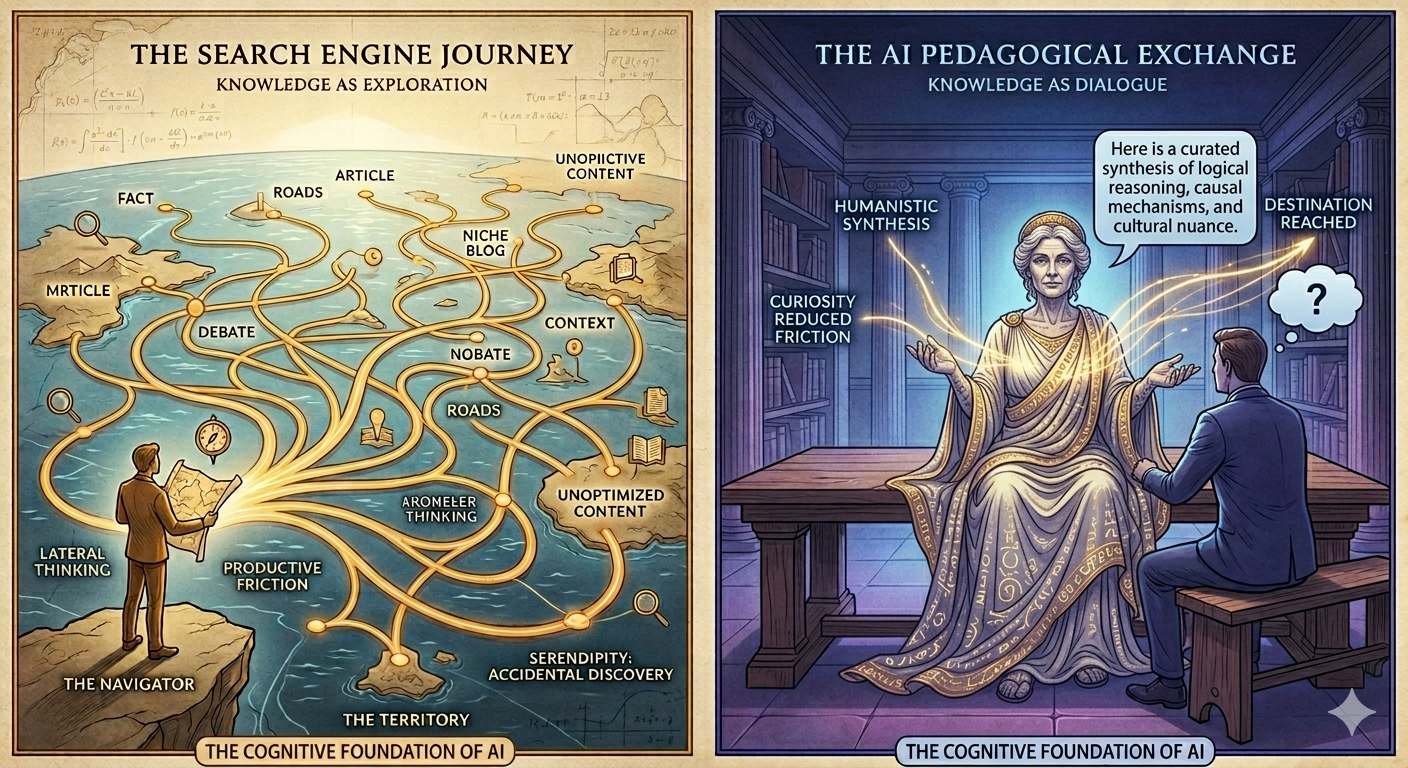
The Search Engine: Knowledge as Journey
For over two decades, the search engine was the dominant interface between humans and digital knowledge. Its underlying metaphor was the journey. You typed a query (a destination) and received a map: a list of links.
- Epistemic Wandering: You chose which path to follow. You could wander, and this wandering was not a flaw but was epistemically productive.
- Serendipity: The search engine rewarded curiosity and lateral thinking, making “serendipity” possible—the discovery of something valuable you were not looking for.
- Active Synthesis: The system did not teach; it pointed to roads. The synthesis (the connection between sources) remained entirely with the reader.
The web was the territory, the search engine was the map, and you were the traveler.
Or also:
The web was the ocean, the search engine was the compass, and you were the navigator.
Generative AI: Knowledge as Pedagogical Exchange
Generative AI operates through a fundamentally different metaphor: the pedagogical exchange. You ask a question, and the system provides a structured answer.
- Destination Over Path: The system does not give you roads; it gives you a destination already reached. There is no map, no journey, and no accidental discovery.
- Collapsing the Space: The gap between question and answer—the space where learning often happens—has been collapsed.
- Instructional Logic: A technology whose core logic is question, synthesis, and response is an instructional technology. Its structure is the structure of teaching.
What We Lose When We Stop Wandering
The disappearance of the journey is not a trivial change. Some of the most important intellectual discoveries happen precisely in the gap between what you were looking for and what you found.
Serendipity requires friction. When AI removes that friction by collapsing the distance between question and answer, it also removes the conditions under which exploratory learning occurs.
“The student who would have spent two hours following links, building a mental map of a complex topic, now receives a summary in forty seconds. The summary may be accurate, but the two hours—and the cognitive growth they fostered—are gone.”
This is not an argument against AI, but an argument for understanding what it is. Educational systems must design around its limitations as clearly as they design around its capabilities.
AI as an Inherently Educational Agent
The fact that AI operates through the metaphor of pedagogical exchange is the natural expression of what it has become: an educational construct.
As I argued in the first article, AI emerged from human knowledge and participated in a process that resembles learning at an extraordinary scale. When you interact with a generative system, you are engaging with a system that has absorbed centuries of scientific literature, cultural production, and everyday thought, synthesizing it into a response. Whether we acknowledge it or not, the structure of that engagement is educational.
A New Set of Questions
Once we understand that AI teaches, a new set of questions becomes unavoidable:
- Who designed the curriculum?
- What values are embedded in the synthesis?
- What gets emphasized, and what gets left out?
- Who is responsible when the teaching is wrong, biased, or incomplete?
These are not technical questions; they are educational and ethical. Historically, universities have been responsible for answering them. If AI is an educational construct teaching at a global scale, and if universities are its “cognitive parents,” what does that responsibility mean in practice?
That is the question the final article in this series will attempt to answer.
Alberto Cecchi is a researcher at Alma Mater Europaea (Maribor, Slovenia), where his research focuses on transparent machine learning for student dropout prediction and policy simulation in higher education. This article is part of a series developing the argument first presented in AI is Education: The Recursive Pedagogy of Artificial Intelligence.