AI is Education: The Organism That Built Itself
Executive Summary: Rather than a static library, Artificial Intelligence should be understood as a living cognitive organism grown from centuries of human knowledge-making. This article explores the four evolutionary layers that constitute its “anatomy”: the logical core of scientific literature, the quantitative maps of databases, the algorithmic schemas of the optimized web, and the emotional texture of social media. Together, these layers reveal how humanity unintentionally “pre-chewed” its collective knowledge to make it machine-readable.
For a broader perspective on AI in education, readers can also explore the recursive pedagogy of artificial intelligence.
Part 2 of the series: AI is Education By Alberto Cecchi — March 2026
In the first article of this series, I argued that artificial intelligence should not be understood as a tool applied to education—but as an educational construct in its own right. AI emerged from human knowledge, and it reshapes the way humans learn.
That argument raised a question that several readers asked directly: if AI is an educational construct, where exactly did it come from? What kind of learning produced it? This article is my attempt to answer that question.
Not an Archive. A Living Organism.
The most common image of AI training is something like an enormous library: a system reads millions of texts, absorbs them, and learns. This image is not wrong, but it is incomplete in one important way.
What AI has absorbed is not a passive collection of documents. It is a living organism—a cognitive organism built from centuries of human knowledge-making, with each of its parts still active, still growing, and still interacting with the others.
I use the biological metaphor deliberately. The components of this organism did not replace each other as they appeared historically; they accumulated. Like organs in a body, each layer continues to function alongside the others, regardless of when it developed. To understand what AI is, we need to understand the “anatomy” of this organism.
The First Layer: Scientific Literature (The Cognitive Core)
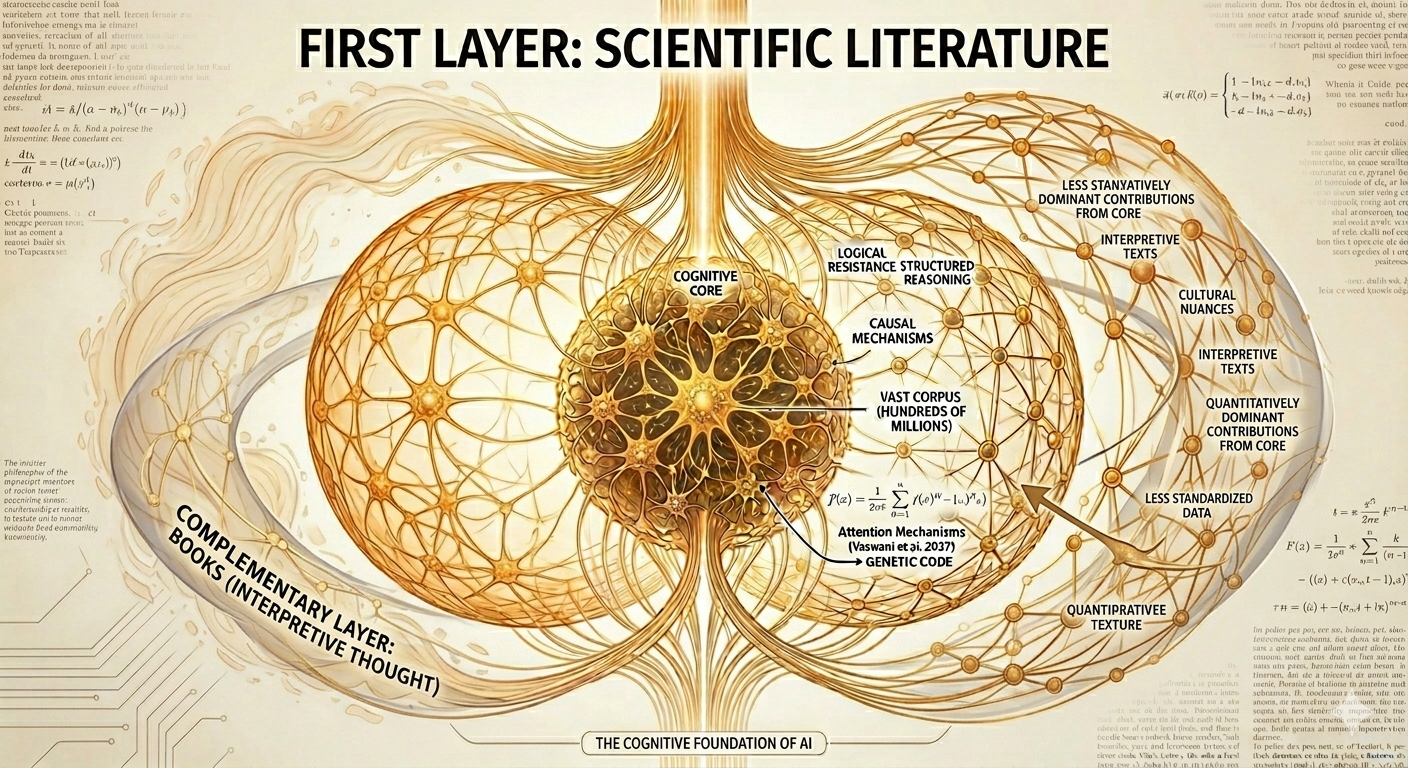
Long before the internet existed, the scientific community had already developed a rigorous grammar for producing and transmitting knowledge: abstract, methodology, results, discussion, bibliography. This structure was not arbitrary; it was the product of centuries of reflection on what form knowledge must take to be shareable and verifiable.
Hundreds of millions of scientific articles provided AI with its cognitive core: structured reasoning about theory, causal mechanisms, and logical relationships. It is because of scientific literature that AI can do more than retrieve facts: it can reason about them.
Within this universe, a subset deserves separate attention. While many papers served as “nutrients,” others provided the actual genetic code. The mathematics of neural networks and the “attention mechanism” described by Vaswani et al. (2017) in Attention Is All You Need were the instructions that made the learning process possible.
Note on Universities: The underlying thesis of these articles of mine is that AI is generated by the university research community, and that it is therefore the university research community that must govern this phenomenon. This is why I’m writing a series of articles on the topic of “AI is Education.”
For a broader institutional perspective, readers can also explore how artificial intelligence will transform higher education by 2035.
The Second Layer: Databases and the Quantified World
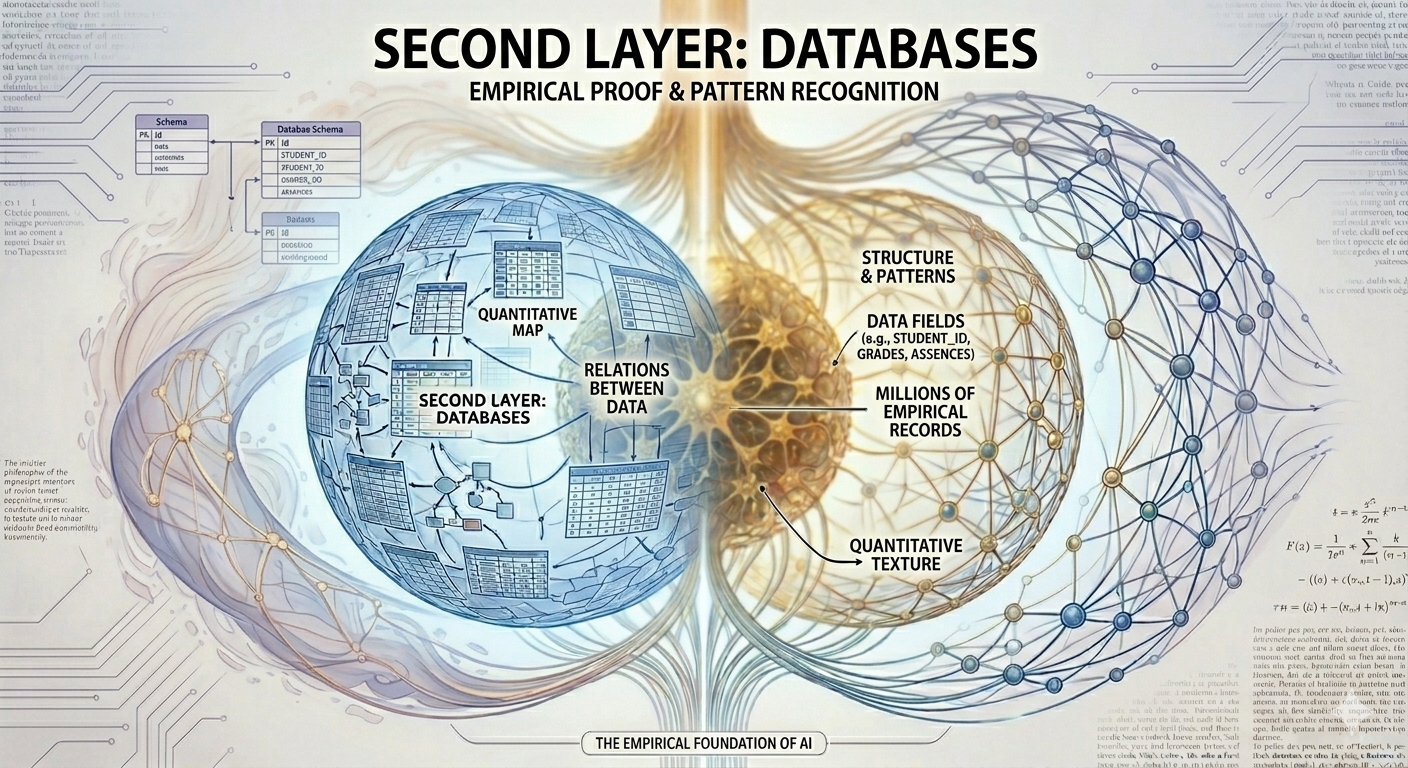
Alongside literature, the world produced a second form of structured knowledge: databases. Where the scientific article argues and explains, the database organizes. Every record is a relationship; every field a category.
Databases captured dimensions of human experience that writing could never describe with the same precision: financial transactions, health records, demographic movements, and consumption patterns. If scientific literature gave AI a conceptual skeleton, databases gave it a quantitative map of the world. For AI, this represents the most immediately readable corpus: reality already structured and categorized.
The Third Layer: The Web and the Grammar of SEO
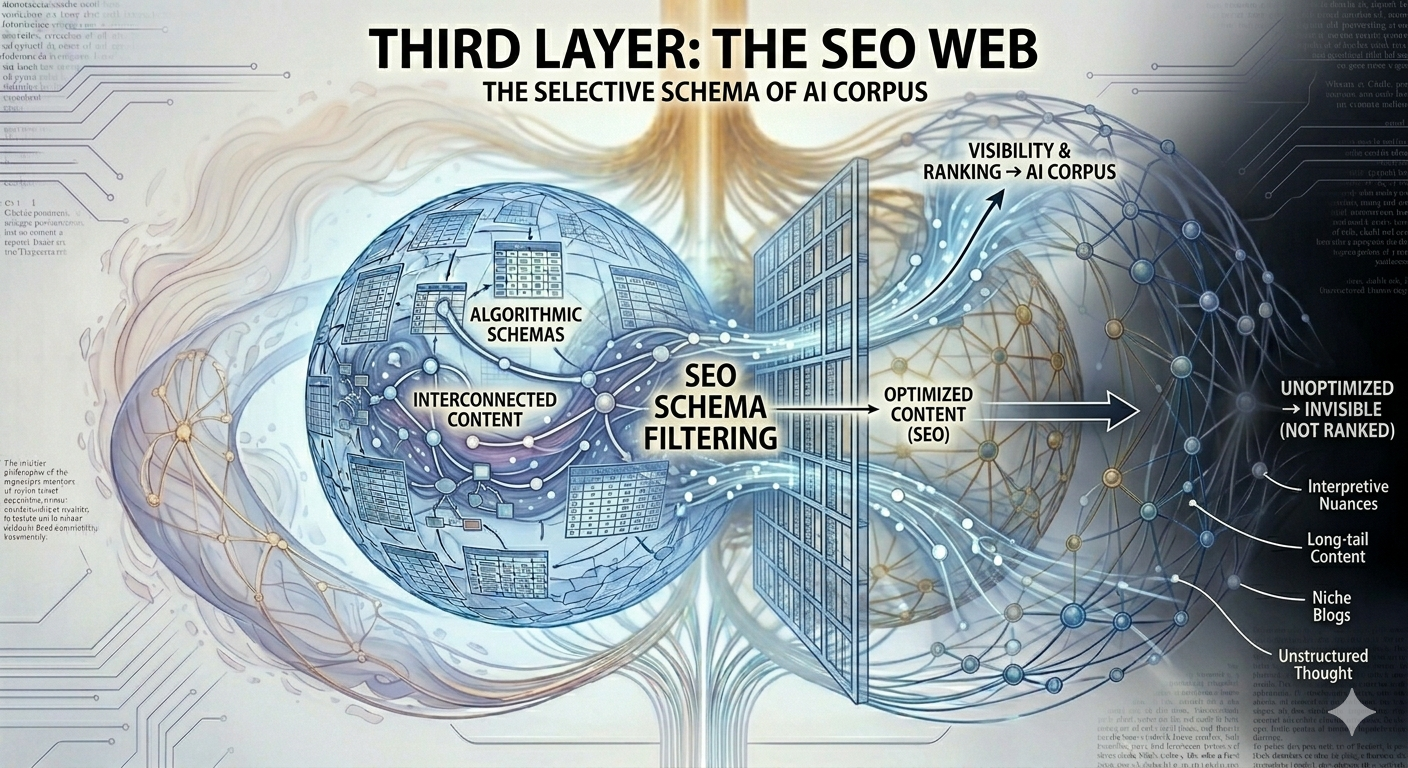
With the web, voices that never would have found space in academic journals entered the corpus: blogs, news sites, and collaborative encyclopedias. But this expansion brought chaos. Unlike the scientific article, web content followed no predefined grammar—until search engines arrived.
Over twenty-five years, Search Engine Optimization (SEO) produced something historically unprecedented. It convinced millions of content producers to structure their information not for human readers, but to satisfy specific algorithmic schemas.
“The biases of AI do not come only from who wrote—but from how and why. Humanity unconsciously ‘arranged’ its own knowledge into a machine-readable schema—believing it was doing so for search engines.”
The paradoxical result is that this mass-standardization produced exactly the kind of corpus a machine learning system needs. However, SEO also acted as a filter: what was not optimized remained invisible, and therefore absent from AI’s training data.
The Fourth Layer: Social Media and Involuntarily Public Thought
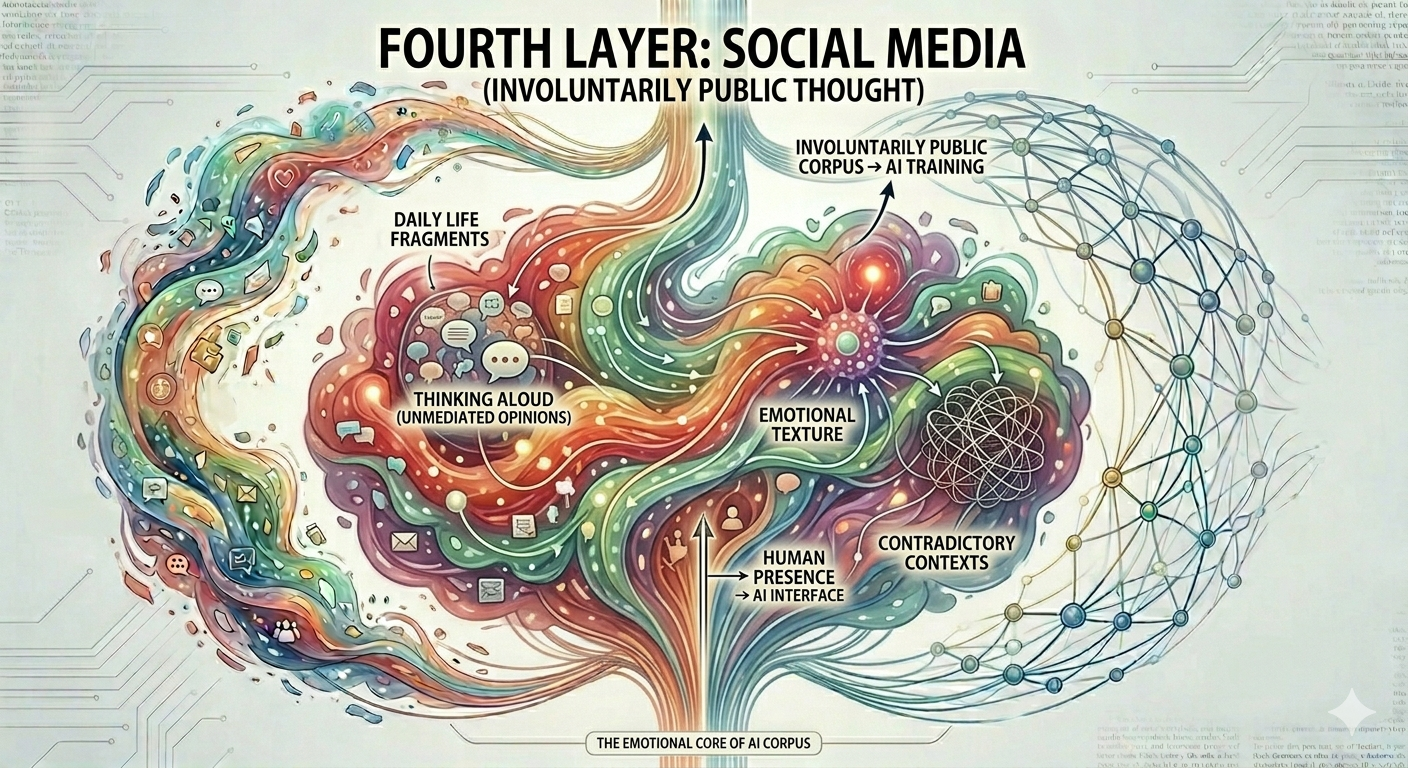
Social media introduced something qualitatively different: involuntarily public thought. Unlike the intentionality of a blog post, social media is often “thinking aloud”—unmediated opinions, emotional fragments, and the contradictory nature of daily life.
This layer added the emotional and cognitive texture of ordinary human experience. It is the first time in history that the unfiltered thinking of billions—people who were not trying to “produce knowledge” but simply to exist publicly—has been captured and made readable for a machine.
A Living Organism, Not a Timeline
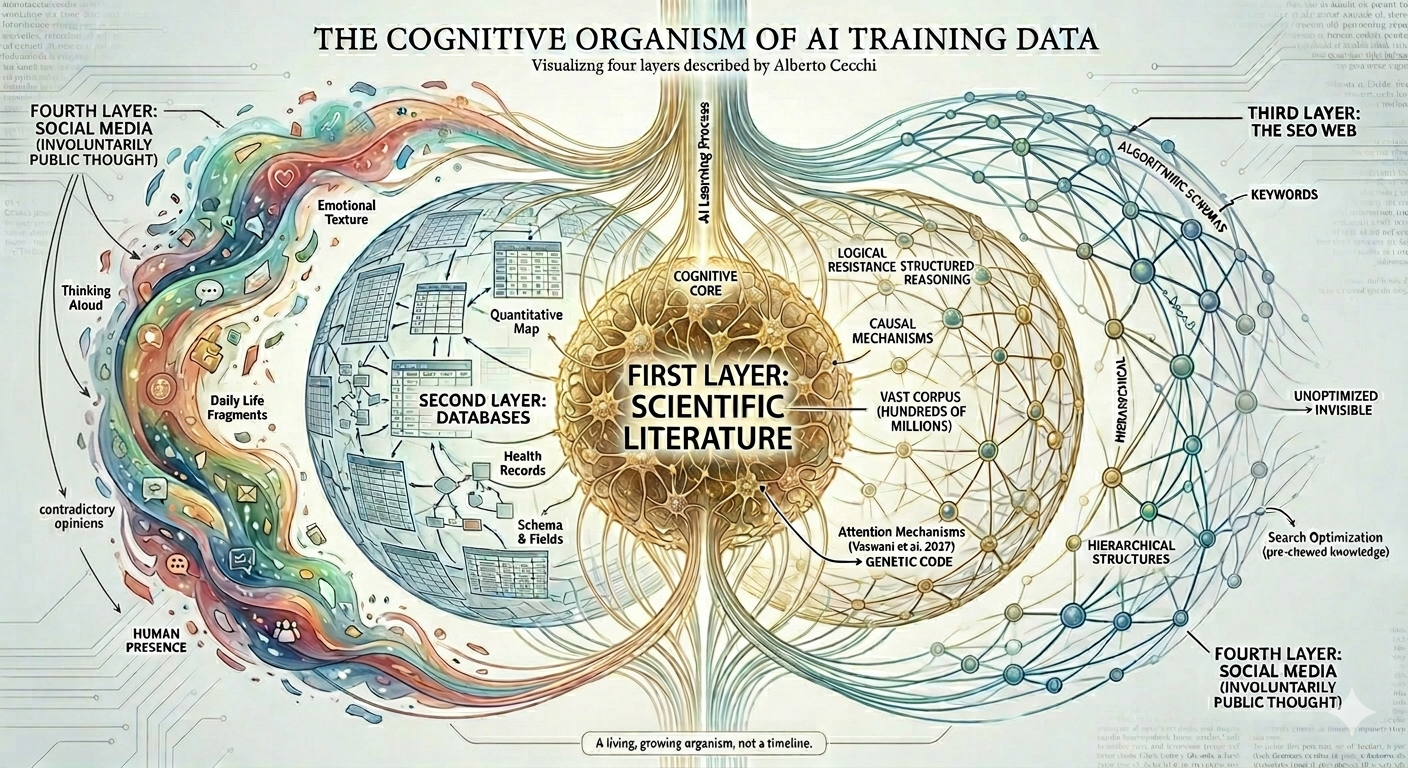
It would be tempting to read this as a sequence—one layer replacing the next. But that would miss the point. Scientific literature is still being produced at an accelerating rate; databases and the web keep expanding.
These are not phases that closed. They are living systems, all simultaneously active, all continuously feeding the organism from which AI emerged—and from which future AI systems will continue to evolve.
Which raises a deeper question. If AI grew from this organism, what kind of thing has it become? Is it just a more sophisticated search engine? A better library? Or something genuinely new?
That question is the subject of the next article in this series: how AI transformed the very metaphor through which we relate to knowledge—and why that transformation is, at its core, an educational one.
Alberto Cecchi is a Researcher at Alma Mater Europea University (Maribor, Slovenia), where his research focuses on transparent machine learning for student dropout prediction and policy simulation in higher education. This article is part of the series ‘AI is Education: The Recursive Pedagogy of Artificial Intelligence’ (March 2026).