The AI Transition We’re Actually Living Through: Labor Markets, Universities, and the Slow Burn of Structural Change
The AI labor market transition is unfolding more slowly and more interestingly than most public narratives suggest. In this analysis, based on an interview with Stanford AI professor Kian Katanforoush, we examine what is genuinely changing in employment, organizational structure, and higher education.
My considerations on interview with Kian Katanforoush conducted by Marina Mogilko for Silicon Valley Girl at the World Economic Forum, Davos 2026.
Key Takeaways
AI is a general-purpose technology reshaping labor markets gradually. Universities are structurally lagging behind labor market needs. The transition is slow, cumulative, not disruptive. Skill mismatch is the central issue.
Definitions
AI Transition: the gradual restructuring of labor markets driven by AI adoption.
Structural Change: reallocation of labor across sectors due to productivity shifts.
Slow Burn Transition: a long-term, cumulative transformation rather than sudden disruption.
There is a particular kind of intellectual dishonesty that has colonized public discourse on artificial intelligence: the tendency to confuse narrative velocity with actual velocity. Headlines move at the speed of Twitter; labor markets move at the speed of institutions. Kian Katanforoush, a Stanford professor and CEO of Workera who has tested over a million people on their AI competencies, offers something rarer than a hot take: a calibrated perspective grounded in data and historical pattern recognition.
His central insight is disarmingly simple, but its implications are far-reaching: we are not witnessing an employment apocalypse. We are witnessing the beginning of a profound structural transition that will unfold over decades, not quarters.
The Automation Mirage: Tasks Are Not Jobs
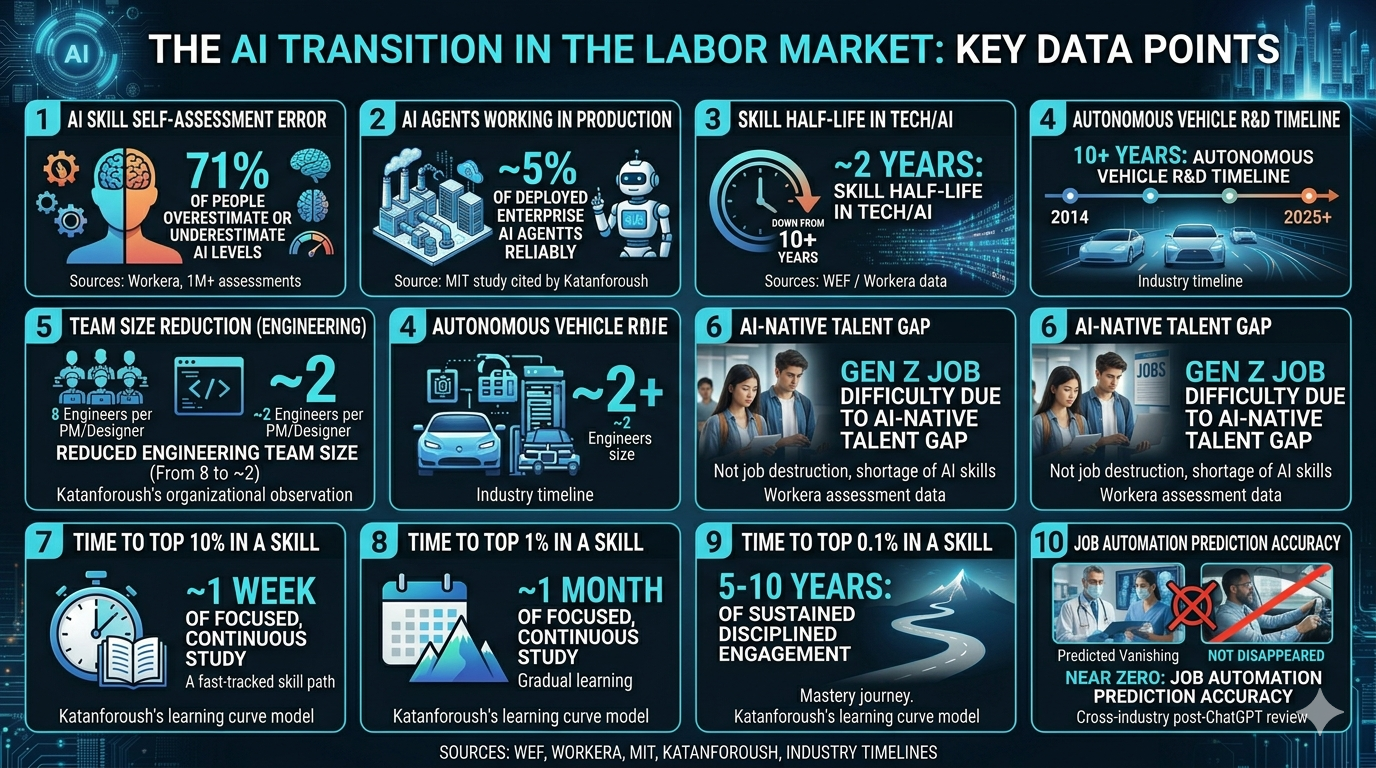
The most important conceptual distinction Katanforoush draws is between task-level automation and job-level displacement. Foundation model laboratories, including Anthropic, OpenAI, and others, publish reports demonstrating that AI can competently perform task A, task B, task C. The rhetorical leap from AI can do these tasks to this job is disappearing is enormous, and almost invariably unwarranted.
Jobs are not tasks. A job is a sociotechnical system composed of hundreds of tasks embedded in organizational structures, interpersonal relationships, tacit knowledge, institutional accountability, and regulatory frameworks. The radiologist who was supposed to be obsolete is still driving to work. The truck driver whose job was meant to vanish is still on the highway. This is not because AI failed to advance: it is because the gap between technical capability at the task level and systemic integration at the job level is extraordinarily wide, and crossing it takes decades.
The timeline of autonomous vehicles is instructive. Serious research and massive capital investment began around 2014 to 2015. More than a decade later, we have limited commercial deployment in a handful of cities, under specific conditions, with ongoing safety incidents and regulatory battles. This is what genuine technological diffusion actually looks like. The six-month disruption predictions that accompanied the launch of ChatGPT were not wrong because the technology was weak: they were wrong because they fundamentally misunderstood how economies absorb technological change.
What we are actually witnessing in the current hiring contraction, particularly in tech, is largely not automation: it is post-pandemic roster correction dressed in AI language. Companies that dramatically overhired between 2020 and 2022 are now performance-managing their workforce back to sustainable ratios. Attributing this to AI serves a convenient narrative for both executives and for those who prefer a technological explanation to a cyclical one. The evidence, however, points toward something far more mundane: companies exiting employees from divisions that simply failed to deliver on their strategic promise.
What Is Actually Changing, and How
This does not mean nothing is changing. Something important is changing: it is simply more subtle and more interesting than the apocalyptic narrative suggests.
The organizational unit is shrinking. What previously required a team of eight engineers, one product manager, and one designer may now be achievable with two engineers in the same roles. Organizations are becoming flatter: senior individual contributors are choosing to return to direct technical work rather than managing people, because AI tools amplify individual output so dramatically that the coordination overhead of team management no longer justifies itself. Teams are smaller, more autonomous, and own larger surface areas of their respective domains.
The skills that command premium value are shifting in counterintuitive ways. Forward-deployed engineering, the capacity to simultaneously understand a business problem deeply and build technical solutions for it, is becoming extraordinarily rare and valuable precisely because AI has lowered the barrier to basic technical production while raising the bar for contextual judgment. Anyone can now generate functional code; far fewer can determine what code should be generated, in which organizational context, to solve which actual problem.
At the technical frontier, three capabilities are commanding outsized market value: the ability to design and implement reasoning loops in large language models; distributed computing expertise sufficient to architect and train models on large-scale clusters; and reinforcement learning specialization, the discipline underpinning the post-training optimization methods that have driven recent benchmark improvements. These are PhD-level specializations, and their scarcity is structural.
The most actionable implication for the broader labor market may be this: career safety in the coming decade will be a function not of what you currently know, but of how rapidly you can acquire new competencies. The competitive advantage accrues to those who have made learning itself their core competency. This is the core dynamic of the AI labor market transition we are living through.
The University Question
The challenge facing universities is structural and deep, though Katanforoush’s analysis suggests the prognosis is more differentiated than either the techno-optimist camp (universities are obsolete) or the traditionalist camp (nothing fundamental is changing) would acknowledge. But to understand what universities should become in the age of AI, it is worth stepping back from the labor market framing entirely and asking a more foundational question: what kind of thing is AI, epistemically speaking?
One productive answer is that AI is best understood as a two-sided educational instrument. It is simultaneously the product of human knowledge and a new actor within the processes by which knowledge is transmitted and generated. AI does not develop intelligence autonomously: its capabilities result from an extensive training phase in which it absorbs scientific literature, cultural materials, and accumulated human understanding on a scale no individual scholar could replicate. In this sense, AI has undergone a form of massive passive learning, and when humans interact with it, the exchange takes on a distinctly pedagogical character. We ask questions; it produces synthesized responses. The structure is dialogical, interpretive, and historically unprecedented.
This reframing has significant implications for how we think about universities. Their authority has long rested on expertise and knowledge mediation, on being the institutional site where validated knowledge is produced, organized, and transmitted. Generative AI does not simply threaten this function; it restructures it. The transition from search engines to generative models marks a qualitative shift in how knowledge is accessed: earlier digital systems indexed and retrieved external sources, while generative AI performs synthesis, connecting information, formulating explanations, generating structured interpretations. What was once the distinctive intellectual labor of the educated expert is now partially delegated to an algorithmic system.
Universities are not primarily in the content business, despite what tuition fees might suggest. They are in the network and credentialing business, with content as a delivery mechanism. The same Stanford lectures posted on YouTube attract hundreds of thousands of views from students who, by their own admission, receive equivalent informational content to their on-campus peers. Yet those YouTube students face a structural disadvantage that has nothing to do with the quality of instruction: they do not know where they stand. They lack the calibration that comes from being embedded in a community where the competitive bar is visible and legible.
The more pressing institutional problem is the skills-market mismatch. Universities are slow-moving bureaucratic organisms whose curriculum cycles operate on timescales of years to decades, while the skills landscape is now shifting on timescales of months. The result is a systematic misalignment between what graduates know and what employers need.
A more sustainable architecture would assign different responsibilities to different institutions. Universities would focus on durable skills, the cognitive capabilities that retain value across multiple technological paradigms: rigorous reasoning, critical thinking, effective communication, and genuine AI literacy. Employers would take responsibility for perishable skills, specific tools, frameworks, and domain-particular competencies that have short half-lives and require continuous updating.
The Hub Problem and the Distribution of Opportunity
There is a geography of opportunity problem embedded in this transition that rarely receives adequate attention. AI is not being developed everywhere equally. It is being developed intensively in a small number of geographic concentrations, principally the San Francisco Bay Area, where informal knowledge transfer happens at dinner tables and the competitive bar is perpetually visible. Living in that ecosystem is itself a form of education that no online platform has yet replicated.
The implication is that geographic proximity to technological development remains a significant advantage, and that the democratization of AI skills, which did eventually occur with software engineering, will likely follow a similar pattern on a similar timescale. Not immediately, not within a product cycle, but over the coming decade as senior practitioners disperse and carry embedded knowledge with them into new contexts.
For those early in their careers, the practical implication is worth stating directly: being in a hub during the formative years of a technology transition compounds in ways that are difficult to replicate through equivalent time spent elsewhere. The content is available everywhere. The calibration, the network density, and the ambient learning are not.
What Remains Durable
Understanding the AI labor market transition means distinguishing what changes from what endures.
Agency tops the list. The capacity to identify problems, take initiative, design solutions, and iterate without requiring external direction is not something that AI systems currently possess or are likely to possess in the near term in any generalized form. It is the meta-competency that determines whether AI serves you or controls you.
Critical thinking, effective communication, and genuine problem-solving capacity follow. These are not platitudes: they are the cognitive capabilities that remain valuable precisely because they are difficult to automate and because they are required to evaluate, direct, and course-correct AI outputs. The engineer who understands enough about what an AI coding agent is doing to catch its errors and redirect its attention is not merely an operator: they are a quality gate, and that function will remain human for longer than most people currently anticipate.
Finally, and perhaps most practically: the habit of learning. Katanforoush’s formulation is memorable: a week of focused effort on a domain places you in the top ten percent of practitioners; a month in the top one percent; sustained disciplined engagement over years in the top 0.1 percent. The leverage that AI tools provide amplifies this effect.
The transition we are living through is real, consequential, and genuinely uncertain in its eventual shape. It is not, however, the discontinuous rupture that media narratives suggest. It is a structural transformation of the kind that economic history has seen before: gradual enough to navigate, fast enough to demand continuous attention, and complex enough to resist any simple story about winners and losers.
Based on an interview conducted by Marina Mogilko with Kian Katanforoush, Stanford AI professor, co-founder of DeepLearning.AI, and CEO of Workera, at the World Economic Forum in Davos, January 2026.