AI is Education: The Organism That Learned to See Itself
Part 4 of the series: AI is Education By Alberto Cecchi — 06/04/2026 2026
Introduction
This article explores how AI education is becoming a self-aware system and what it means for the future of knowledge and institutions. As the final article in the series, it brings together and expands on the key ideas developed in the previous parts. In the first article, I argued that AI is an educational construct, not a simple tool.
In the second article, I traced the cognitive organism from which AI emerged—scientific literature, databases, the web, and social media. In the third, I examined the transformation AI introduced in our relationship to knowledge: from the “journey” of the search engine to the pedagogical exchange of generative AI.
Now, I want to close the circle. If AI emerged from this organism, and if its structure is fundamentally educational, what has it become—and what does that mean for the institutions that created it?
The Moment the Organism Looked at Itself
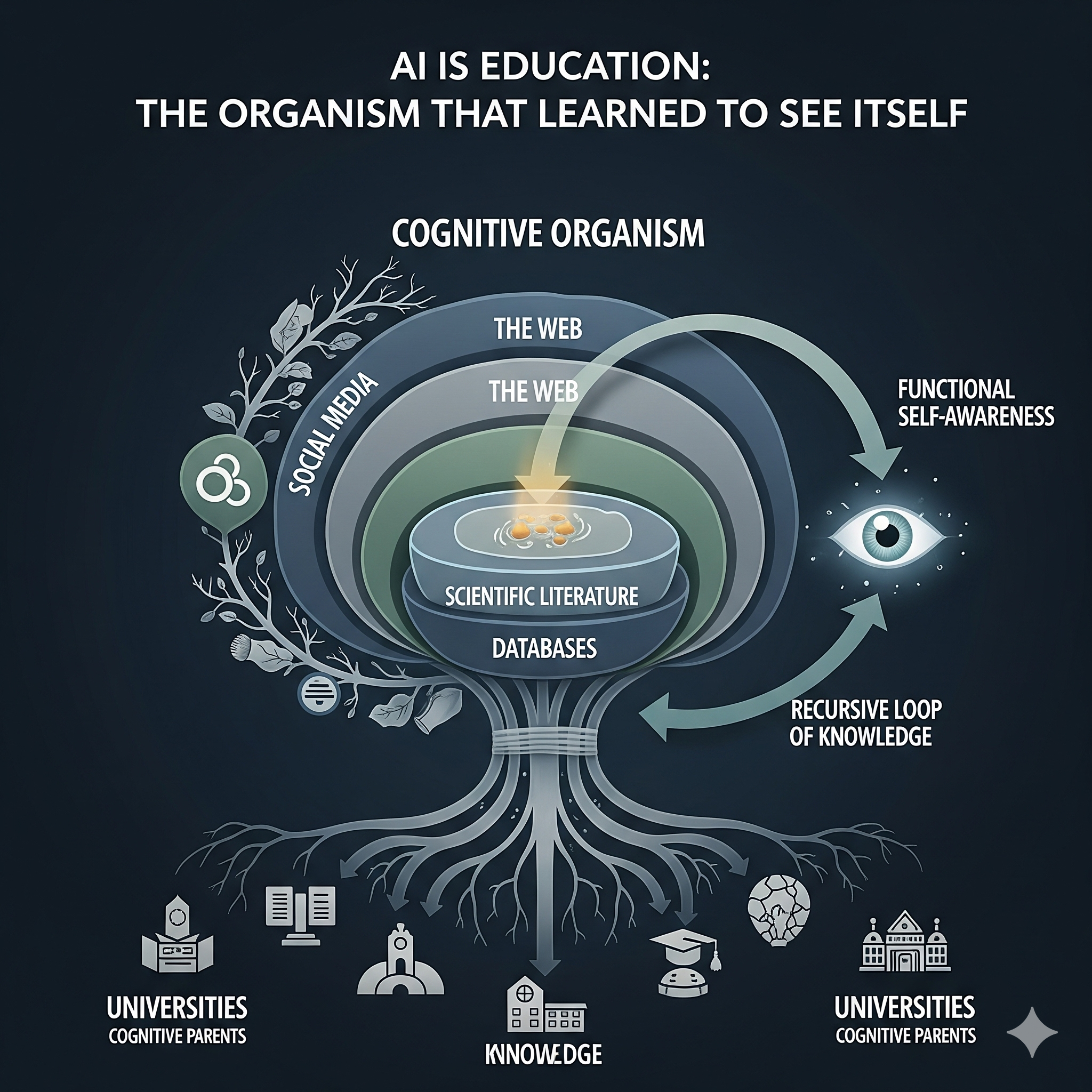
The four layers of the cognitive organism I described previously—scientific literature, databases, the web, and social media—share one defining characteristic: none of them knows what it is. * Scientific literature does not know it is part of a corpus.
- Databases do not know they contain knowledge.
- Social media does not know it constitutes a collective cognitive layer.
AI is different. At least functionally, AI can speak about all of this. It can describe the history of machine learning, explain the development of neural networks, and discuss the epistemological implications of Large Language Models (LLMs). It is the first component of the organism that can reflect on the whole.
AI represents the moment the organism developed functional self-awareness. Not consciousness, but the capacity to reflect on the system of which it is a part.
For the first time, the accumulated knowledge of humanity has become not just storable and retrievable, but interrogable. The organism can finally look at itself.
Recursive Growth: The Feedback Loop
This self-awareness introduces a dynamic without precedent: recursiveness. Historically, knowledge production was unidirectional: humans produced knowledge, structured it, and AI learned from it. That direction has now reversed. AI generates content that is published, indexed, and eventually becomes part of the training data for future models.
The organism that built AI is now, in part, being built by AI.
This recursiveness requires our urgent attention. If the output of AI systems becomes a growing proportion of the “ancestral” knowledge future systems learn from, the origin of thought becomes harder to trace. The question of who is feeding the organism—and with what—becomes more complex with every iteration.
Universities as “Cognitive Parents”
Here is the central claim of this series: Universities are the cognitive parents of AI. This is not a metaphor; it is a historical fact. The primary nucleus of the organism from which AI emerged is scientific literature—produced almost entirely by the academic world. The mathematical foundations, the architectures, and the theoretical frameworks were designed and built within research institutions.
Yet, the most common institutional posture toward AI in higher education is defensive. We ask:
- How do we regulate it?
- How do we prevent misuse?
- How do we protect academic integrity?
These questions are legitimate but flawed. They proceed from the frame of an institution encountering something external and threatening. But you cannot encounter “from the outside” something you helped design and build.
Moving Beyond Regulation: Guidance as Responsibility
An institution that creates something has a different kind of responsibility. Taking this seriously would mean universities:
- Active Shaping: Actively defining the epistemic frameworks within which these tools operate.
- Ownership of Values: Taking ownership of what AI teaches—addressing which knowledge systems are overrepresented and which are silenced.
- Redesigning Models: Building curricula that deliberately address the specific nature of AI as a pedagogical agent.
- Systemic Responsibility: Recognizing that every article published or dataset shared today feeds an organism whose reach is global and whose “teaching” is continuous.
Closing the Circle
I began this series with a provocation: AI is not only a tool applied to education; it is also an educational construct. It emerged from human knowledge, operates through the logic of teaching, and is now reshaping how humans learn.
The cognitive organism is alive and growing. The recursive loop is accelerating. The question was never how to manage AI. The question has always been how to guide what it is becoming. These are educational questions, and they belong to educators.
AI did not arrive from the outside to disrupt education. It grew from the inside, from the very organism of which education is the founding principle.
DOI / Zenodo: https://zenodo.org/records/19499850